

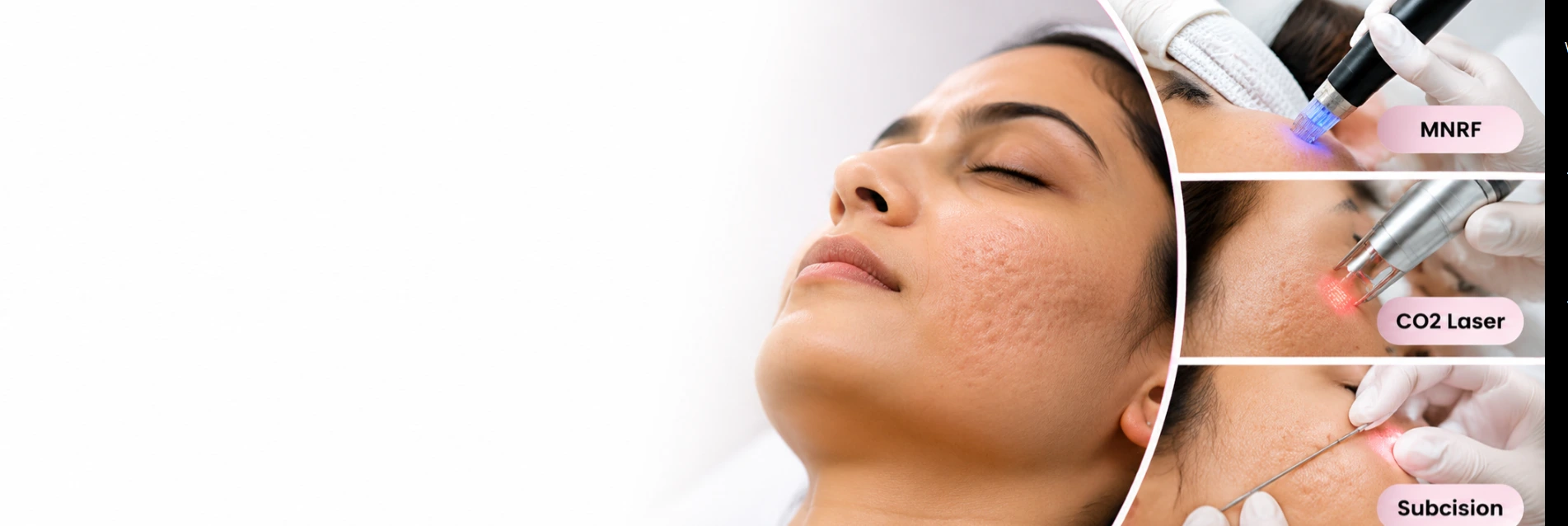
Acne may disappear, but the scars it leaves behind can remain for years. Uneven skin texture, deep pits and visible facial scars are common concerns for people who have experienced persistent or severe acne.
Many people explore professional acne scar treatments after discovering that creams and home remedies cannot fully correct deep scars.
Three commonly used treatment options are MNRF (Microneedling Radiofrequency), Fractional CO2 Laser and Subcision. Each works differently and is suitable for different types of acne scars.
If you are considering acne scar treatment in Thane, understanding these differences can help you make an informed decision.
At Dermatrix Clinic, treatments including MNRF, Fractional CO2 Laser and Subcision are available for selected acne scar concerns.
This guide explains how each treatment works, which scars may respond, expected recovery and why combining procedures is sometimes recommended.
Why Do Acne Scars Form?
Acne scars develop when inflammation damages the deeper layers of the skin. During healing, the body produces collagen to repair the affected area.
If insufficient collagen is produced, the skin may develop depressed scars. Excess collagen can create raised scars.
The severity of scarring can depend on acne inflammation, genetics, delayed treatment and repeated picking or squeezing of pimples.
Unlike temporary acne marks, true acne scars involve changes in skin structure. This is why professional procedures may be considered for persistent scarring.
Understanding the Different Types of Acne Scars
Before choosing between MNRF, CO2 laser and subcision, it is important to identify your scar type.
1. Ice Pick Scars
Ice pick scars are narrow, deep depressions that extend into the skin. They resemble small punctures.
These scars can be difficult to treat with resurfacing alone. Targeted procedures, such as TCA CROSS or punch techniques, may be considered by dermatologists.
2. Boxcar Scars
Boxcar scars are round or oval depressions with relatively defined edges. They may be shallow or deep.
Selected boxcar scars can improve with collagen-remodelling procedures, including MNRF or fractional laser treatment.
3. Rolling Scars
Rolling scars create broad, wave-like depressions across the skin.
They are often caused by fibrous bands pulling the skin downward. Subcision may be particularly useful when these bands are responsible for the depression.
4. Post-Acne Marks
Brown or red marks left after acne are not necessarily true scars.
These changes involve pigmentation or redness rather than permanent depressions. They may require different treatment approaches.
Important: Many people have more than one scar type. A dermatologist may recommend a combination of treatments instead of relying on a single procedure.
What Is MNRF Treatment for Acne Scars?
MNRF stands for Microneedling Radiofrequency. It combines fine needles with controlled radiofrequency energy to stimulate collagen remodelling within the skin.
During treatment, the device creates tiny controlled injuries while delivering RF energy at selected depths.
As the skin heals, collagen production and remodelling may help reduce the appearance of depressed acne scars and uneven texture.
Benefits of MNRF Treatment
MNRF may help improve:
-
Selected rolling and boxcar scars
-
Uneven skin texture
-
Certain enlarged-looking pores
-
Mild skin laxity
-
Overall skin smoothness
Because MNRF is not an ablative laser, it can be an option for people who want to avoid the surface resurfacing associated with fractional CO2 treatment.
It may also be considered for darker skin tones, although pigmentation changes and other side effects remain possible.
How Many MNRF Sessions Are Required?
Dermatrix's MNRF service information generally mentions 3–4 sessions, spaced approximately four to six weeks apart.
The actual treatment plan depends on scar depth, skin condition and individual response.
MNRF Recovery Time
Temporary redness, swelling, sensitivity or small pinpoint marks may occur.
Recovery varies with the device settings and treatment intensity. Some patients resume ordinary activities relatively quickly, but temporary changes may remain visible for several days.
Explore MNRF Treatment at Dermatrix Clinic.
What Is Fractional CO2 Laser Treatment?
Fractional CO2 Laser is an ablative skin resurfacing procedure that uses controlled laser energy to treat small areas of the skin.
The laser creates microscopic treatment zones, removing portions of damaged surface tissue and stimulating collagen remodelling during healing.
This process may improve depressed acne scars, rough texture and certain signs of skin ageing.
Benefits of Fractional CO2 Laser
Fractional CO2 laser may help:
-
Improve selected boxcar and rolling scars
-
Reduce uneven skin texture
-
Smooth rough or irregular skin surfaces
-
Stimulate collagen remodelling
-
Improve certain superficial fine lines
The treatment can offer meaningful improvement in suitable patients, but results depend on scar characteristics and the settings used.
Is CO2 Laser Effective for Deep Acne Scars?
Fractional CO2 laser may improve some deep scars, especially selected boxcar scars. However, very narrow ice pick scars and strongly tethered rolling scars may require additional procedures.
A combination of scar-release techniques and resurfacing may provide a more suitable approach for certain patients.
CO2 Laser Recovery Time
Fractional CO2 laser typically involves more visible recovery than MNRF.
Redness, swelling, peeling and crusting may develop during healing. Initial surface recovery can take around one to two weeks, depending on treatment intensity, while redness may persist longer.
There is also a risk of post-inflammatory hyperpigmentation, particularly in darker skin tones.
Explore Fractional CO2 Laser Treatment at Dermatrix.
What Is Subcision Treatment for Acne Scars?
Subcision is a minor dermatological procedure used to treat certain depressed acne scars.
Some scars remain attached to deeper tissues by fibrous bands. These bands pull the skin downward, creating visible depressions.
During subcision, a qualified clinician uses a specialised needle or cannula beneath the skin to release these bands.
Once released, the depressed area may rise, reducing the appearance of the scar.
Benefits of Subcision
Subcision may help:
-
Release tethered acne scars
-
Improve selected rolling scars
-
Reduce the depth of certain depressed scars
-
Improve skin contour
-
Prepare tethered scars for additional resurfacing treatments
Unlike MNRF and CO2 laser, subcision primarily addresses the fibrous attachments beneath the scar.
Is Subcision Suitable for Every Scar?
No. Subcision is most useful when the scar is pulled downward by fibrous tissue.
It may be less effective as a standalone treatment for narrow ice pick scars or superficial pigmentation marks.
Subcision Recovery Time
Bruising, swelling, tenderness and temporary discoloration are common possible effects.
Recovery varies, and bruising can remain visible for several days or longer. Less common risks include bleeding, infection, hematoma and injury to nearby structures.
Subcision should be performed by a suitably trained medical professional.
Explore Subcision Treatment at Dermatrix Clinic.
MNRF vs CO2 Laser vs Subcision: Key Differences
Although all three treatments can improve selected acne scars, they work in different ways.
| Feature | MNRF | Fractional CO2 Laser | Subcision |
|---|---|---|---|
| Method | Microneedling with RF energy | Ablative laser resurfacing | Releases fibrous scar bands |
| Main action | Collagen remodelling | Resurfacing and collagen remodelling | Lifting tethered scars |
| Often considered for | Mixed shallow-to-moderate atrophic scars | Selected boxcar and rolling scars | Tethered rolling scars |
| Recovery | Often shorter | Usually longer | Bruising and swelling possible |
| Main limitation | May not release deep tethering | Greater pigmentation and downtime risks | Does not resurface the skin |
| Sessions | Usually a series | One or multiple | One or multiple |
This comparison is a general guide, not a personal treatment recommendation.
Which Treatment Is Best for Your Acne Scar Type?
There is no single best acne scar treatment for everyone.
For rolling scars: Subcision may help when fibrous bands are pulling the skin downward. MNRF or fractional CO2 laser may subsequently improve the surrounding texture.
For boxcar scars: MNRF and fractional CO2 laser may be considered, depending on scar depth and skin type. Deep, sharply defined scars may require targeted procedures.
For ice pick scars: These narrow scars may respond better to techniques such as TCA CROSS or punch procedures than to MNRF, CO2 laser or subcision alone.
For mixed acne scars: A dermatologist may recommend combining procedures to address different scar characteristics.
For darker skin tones: The risk of pigmentation changes is an important consideration. MNRF may offer a more favourable recovery profile for some patients, while carefully selected laser settings may still be appropriate for others.
The final decision should be based on professional assessment rather than the popularity of a particular procedure.
Can MNRF, CO2 Laser and Subcision Be Combined?
Yes. Combination treatment is sometimes considered for people with multiple scar types or deep tethered scars.
For example, subcision may first be used to release fibrous bands beneath rolling scars. MNRF or fractional CO2 laser may then be considered to improve the texture of the surrounding skin.
These procedures are not necessarily performed during the same appointment. Their sequence and timing depend on healing, skin condition and the dermatologist's treatment plan.
Combination care may improve outcomes for selected patients, but it can also increase treatment complexity, recovery requirements and cost.
What Results Can You Expect from Acne Scar Treatment?
The aim of acne scar treatment is usually to make scars less noticeable, not to guarantee completely scar-free skin.
Improvement depends on scar depth, type, age, skin tone and individual healing.
Collagen remodelling occurs gradually. With MNRF and laser treatments, visible changes may continue developing over several weeks or months.
Subcision may improve the contour of tethered scars, although swelling immediately after treatment can temporarily affect their appearance.
Some scars require repeated sessions or different procedures.
Patients should discuss realistic goals, risks and expected improvement with their dermatologist before starting treatment.
What Is the Cost of Acne Scar Treatment in Thane?
The cost of acne scar treatment in Thane depends on several factors.
These include the scar type and severity, treatment area, selected procedure, number of sessions and whether combination treatment is recommended.
MNRF, Fractional CO2 Laser and Subcision have different equipment, clinical and aftercare requirements.
For this reason, comparing only the price of one session may not reflect the overall treatment plan.
A consultation can help determine which procedure is appropriate and provide a personalised cost estimate.
How to Care for Your Skin After Acne Scar Treatment
Proper aftercare is important for recovery and may help reduce complications.
Follow your dermatologist's instructions, particularly when caring for skin treated with an ablative laser.
General recommendations include:
-
Use prescribed skincare products as directed.
-
Avoid picking, rubbing or scratching the treated skin.
-
Protect your skin from sun exposure.
-
Avoid introducing harsh exfoliating products too early.
-
Keep follow-up appointments.
-
Contact your clinic if you develop worsening pain, spreading redness, fever or unusual discharge.
Post-treatment advice differs between MNRF, fractional CO2 laser and subcision, so always follow your individual treatment instructions.
Acne Scar Treatment at Dermatrix Clinic in Thane
Choosing an acne scar treatment begins with understanding the nature of your scars.
Dermatrix Clinic offers treatment options including MNRF, Fractional CO2 Laser and Subcision for patients seeking improvement in acne-related skin texture and scarring.
During a consultation, factors such as scar type, skin tone, treatment history, active acne and expected downtime can be discussed before selecting an appropriate approach.
Dermatrix has clinic locations in Thane, including Manpada and Panch Pakhdi, serving patients from Thane West and surrounding areas.
Learn more about Acne Scar Treatment at Dermatrix Clinic and enquire about an individual assessment.
Which Acne Scar Treatment Should You Choose?
MNRF, Fractional CO2 Laser and Subcision can all play valuable roles in improving acne scars, but they are not interchangeable.
MNRF focuses on collagen remodelling, CO2 laser helps resurface uneven skin, and subcision releases fibrous bands beneath certain depressed scars.
For patients with mixed or deep scarring, a combination of procedures may sometimes be more appropriate than one treatment alone.
Looking for acne scar treatment in Thane?
Explore Dermatrix Acne Scar Treatment and book a consultation to understand your scar type, available treatment options and expected results.
 Contact us
 Book Appointment
