


Female Hair Transplant
Explore female hair transplant options at Dermatrix. Learn about suitability, donor hair assessment, hairline restoration, procedure, recovery and costs.
Personalized Hair Restoration for Women with Suitable Patterns of Hair Loss
Female Hair Transplant is a surgical hair restoration procedure that involves moving healthy hair follicles from a suitable donor area to selected areas of the scalp affected by permanent hair loss.
Unlike many common patterns of male baldness, hair loss in women often appears as a widening hair part, reduced volume across the central scalp or thinning around the frontal hairline. These differences make accurate diagnosis and donor hair assessment especially important before considering surgery.
At Dermatrix, hair restoration consultations focus on understanding the underlying cause of hair loss, evaluating donor follicle suitability and discussing treatment options based on individual needs.
Whether you are concerned about a receding hairline, localized thinning or changes in hair density, a detailed scalp evaluation can help determine whether female hair transplantation may be appropriate.
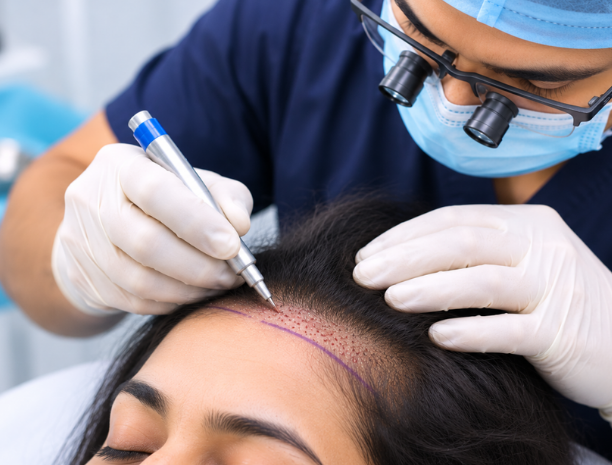
What Is Female Hair Transplant?
A Female Hair Transplant, also called a Women's Hair Transplant, is a surgical procedure that relocates healthy follicular units from a suitable donor area into selected areas requiring additional hair coverage. Hair transplantation for women can involve established methods such as Follicular Unit Excision (FUE) or Follicular Unit Transplantation (FUT), depending on the patient's donor hair characteristics, treatment area and clinical suitability. The purpose is to redistribute existing healthy hair follicles rather than create new follicles. However, female hair restoration requires particular care because many women experience diffuse thinning instead of clearly defined bald areas.
How Is Female Hair Transplant Different from Male Hair Transplant?
The underlying surgical principles are similar, but the pattern of hair loss and treatment planning may differ.
Women often experience:
- Widening of the central hair part.
- Gradual reduction in overall hair volume.
- Thinning around the frontal or temporal hairline.
- Diffuse thinning across the upper scalp.
- Localized hair loss associated with traction or previous injury.
Unlike many men with a clearly defined bald area and relatively preserved donor hair, some women have thinning that extends into the potential donor region. This can reduce the number of suitable follicles available for transplantation.
For this reason, female hair restoration begins with identifying the cause of hair loss and establishing whether a sufficiently healthy, stable donor area exists.
Learn more about the general surgical procedure through our Hair Transplant Treatment page.
An Individualized Approach to Women's Hair Restoration
Female hair transplantation should not be recommended solely because someone is experiencing thinning or reduced hair volume.
A thorough evaluation helps determine whether the problem can be managed medically, whether transplantation may be useful or whether another approach would be more appropriate.
Dermatrix focuses on personalized hair and scalp assessment to help women understand their available restoration options.

4.8

1000 Verified Reviews
Female Hair Loss Evaluation
The consultation considers hair-loss history, the distribution of thinning, scalp condition and potential contributing medical or hormonal factors.
Detailed Donor Hair Assessment
The donor area is evaluated for follicle density, hair thickness and signs of miniaturization that may affect transplant suitability.
Individual Hairline Planning
For suitable candidates, restoration planning considers the existing hairline, facial proportions, surrounding hair density and long-term appearance
Treatment Selection Based on Diagnosis
Surgical and nonsurgical options are discussed according to the identified cause of hair loss and the patient's clinical requirements.
Realistic Expectations and Follow-Up
Patients receive guidance on achievable coverage, donor limitations, recovery and the possibility of continued hair thinning outside the transplanted area.
Which Types of Female Hair Loss May Be Suitable for Hair Transplantation?
Not every woman experiencing hair loss is a candidate for surgery. The cause of hair loss, stability of the condition and quality of the donor hair are essential considerations.
1. Female Pattern Hair Loss
Female pattern hair loss, also known as female androgenetic alopecia, commonly causes gradual thinning over the central or upper scalp.
Some women may be suitable for transplantation when donor hair remains sufficiently dense and relatively stable. However, diffuse thinning across both recipient and donor regions may make surgery unsuitable.
2. Receding Hairline in Women
Some women experience changes in the frontal hairline or localized recession. Hair transplantation may be considered when the underlying cause is understood, the condition is suitable for surgery and sufficient donor follicles are available.
3. Localized Permanent Hair Loss
Women with a clearly defined area of permanent hair loss may be evaluated for transplantation. The location, size, underlying diagnosis and condition of the surrounding skin influence suitability.
4. Stable Traction-Related Hair Loss
Repeated tension from tight hairstyles, extensions or other styling practices can contribute to traction alopecia.
If the cause has been addressed, the condition is stable and follicles have been permanently lost, transplantation may be considered in selected cases. Active traction or ongoing inflammation should be managed before considering surgical restoration.
5. Selected Scarring-Related Hair Loss
Hair transplantation may sometimes be considered for certain stable areas of scarring after specialist assessment. Active inflammatory scarring alopecia is generally unsuitable for transplantation until the underlying disease is adequately controlled. Even in stable cases, outcomes can be less predictable.
Why Some Women Need Hair Loss Treatment Before Surgery
Female hair loss can develop for several reasons, and a hair transplant is not appropriate for every diagnosis. Some conditions require investigation or medical management rather than immediate surgery.
Postpartum Hair Shedding
Temporary hair shedding after childbirth is common. Hair transplantation is generally not the first approach for this type of shedding.
Iron Deficiency or Nutritional Problems
Nutritional deficiencies may contribute to hair shedding. The underlying cause should be identified and addressed before considering transplantation.
Thyroid-Related Hair Loss
Thyroid disorders can affect the hair growth cycle. Appropriate diagnosis and treatment are important before evaluating long-term hair restoration.
Hormonal Changes
Hormonal conditions, including some cases associated with polycystic ovary syndrome or menopause, may contribute to changes in hair density. Treatment decisions should follow an individual clinical assessment.
Telogen Effluvium
Telogen effluvium often causes widespread shedding following illness, stress, hormonal changes or other triggers. The underlying cause should be investigated rather than assuming surgery is required.
Alopecia Areata or Active Scalp Disease
Autoimmune or inflammatory forms of hair loss require diagnosis-specific management. Hair transplantation is not routinely appropriate for active alopecia areata or active scarring alopecia.
Why Diagnosis Matters
A hair transplant redistributes existing follicles. It does not treat every underlying cause of hair loss. When hair follicles remain present but are producing thinner hair, nonsurgical management may be more appropriate.
Explore our Hair Loss Treatment page for information about diagnosis-led hair and scalp care.
How Is Donor Hair Evaluated in Women?
Donor hair evaluation is one of the most important considerations in female hair transplantation.
The donor region is usually located toward the back and sides of the scalp. In suitable patients, this area may contain follicles that are relatively resistant to the processes contributing to pattern hair loss.
However, some women experience follicular miniaturization throughout the scalp, including the potential donor region.
What Does the Doctor Check?
- Donor Density : The number and distribution of follicles available for harvesting.
- Hair Shaft Characteristics : Hair thickness, texture and other characteristics that influence visible coverage.
- Follicular Miniaturization : The presence of progressively finer hair follicles, including within potential donor areas.
- Hair Loss Stability : Whether the condition is relatively stable or progressing rapidly.
- Recipient Area The size of the thinning region, existing hair density and the amount of additional coverage that may realistically be achieved.
- Long-Term Donor Preservation : The need to preserve healthy donor hair for potential future changes in hair density. A scalp examination and trichoscopy may be used, with additional investigations recommended when clinically indicated. If donor follicles are insufficient or unstable, a doctor may recommend nonsurgical management instead.
How Does Female Hair Transplant Work?
The surgical process is planned according to the patient's diagnosis, donor hair availability and restoration goals.
Step 1: Female Hair Loss Consultation
The consultation includes a review of the patient's hair-loss history, pattern of thinning, previous treatments, relevant medical history and expectations. The clinician evaluates possible medical causes and whether further investigations are necessary.
Step 2: Scalp and Donor Assessment
The donor and recipient areas are examined for hair density, follicle characteristics, miniaturization and scalp health. This helps determine whether suitable follicles are available for transplantation.
Step 3: Hairline and Coverage Planning
If transplantation is appropriate, the proposed restoration area is planned. For some women, this may involve localized frontal hairline restoration. In other suitable cases, the goal may be to improve coverage in a defined thinning area. The expected level of improvement should be discussed before treatment.
Step 4: Surgical Technique Selection
The treating surgeon determines whether FUE, FUT or another appropriate implantation approach is suitable. The decision may consider donor hair availability, hairstyle preferences, required graft count and the need to preserve surrounding hair.
Step 5: Donor Follicle Harvesting
Under an appropriate anaesthesia plan, suitable follicular units are harvested from the selected donor region. The harvesting process varies according to the chosen technique.
Step 6: Recipient-Site Preparation and Graft Placement
The recipient area is prepared according to the surgical plan. Harvested follicular units are placed at carefully selected angles, directions and depths to complement existing hair and support natural-looking coverage.
Step 7: Post-Procedure Care and Follow-Up
After transplantation, patients receive instructions for scalp care, graft protection, activity restrictions and follow-up. Transplanted hair commonly undergoes a period of temporary shedding before new growth becomes visible.
Can Women Have a Hair Transplant Without Shaving Their Entire Head?
One of the common concerns among women considering transplantation is whether they will need to shave their hair.
Some FUE procedures may be performed using a limited-shave or unshaven approach, depending on the treatment plan, donor area, graft requirement and surgical team's experience.
In selected cases, a small donor region may be trimmed and concealed beneath longer surrounding hair. However, a completely unshaven procedure is not suitable or practical for every patient.
The appropriate approach depends on:
- The selected harvesting technique.
- Number of grafts required.
- Donor hair density.
- Existing hair length and hairstyle.
- Access to the donor and recipient areas.
- Surgical safety and technical requirements.
Patients should discuss shaving requirements before scheduling a procedure.
Important: Female hair transplantation does not automatically mean no shaving is required.
Female Hairline Restoration
Can Hair Transplantation Restore a Woman's Hairline?
Selected women with permanent frontal or temple hair loss may be considered for hairline transplantation.
A natural-looking hairline requires careful assessment of facial proportions, existing hair direction, follicle characteristics and long-term stability.
What Makes Female Hairline Planning Different?
- Natural Hairline Shape : The proposed hairline should complement facial anatomy and existing hair rather than follow one fixed design.
- Fine Hair Selection : Appropriate follicular units may be selected for the frontal hairline to help create a natural transition.
- Hair Growth Direction : Implantation angles should be planned to complement nearby hair growth.
- Future Hair Loss : The surgical plan should consider whether existing hair may continue thinning over time.
- Donor Availability: An appropriate balance is needed between the desired coverage and the number of follicles that can safely be harvested.
A consultation helps determine whether hairline restoration is appropriate and what result may realistically be achieved.
What Are the Potential Benefits of Female Hair Transplant?
For appropriately selected women, transplantation may provide a surgical option for restoring coverage in areas of permanent hair loss.
Restoration of Selected Thinning Areas
Hair follicles can be moved into suitable areas where additional coverage is needed.
Personalized Hairline Design
Graft placement can be planned around the patient's facial proportions and natural hair characteristics.
Use of the Patient's Own Follicles
The procedure uses suitable donor follicles collected from the patient's scalp.
Long-Term Hair Growth Potential
Transplanted follicles from stable donor areas may continue producing hair over the long term.
Individualized Treatment Planning
The restoration area, graft number and surgical method can be selected according to clinical requirements.
Important Limitations of Female Hair Transplant
A female hair transplant cannot guarantee a particular increase in hair density, completely restore the original volume or prevent future hair thinning.
Outcomes depend on donor hair quality, the underlying diagnosis, graft survival, surrounding hair and individual healing. For women with widespread diffuse thinning, surgery may offer limited benefits or may not be recommended.
Female Hair Transplant vs Nonsurgical Hair Loss Treatments
Hair transplantation and nonsurgical hair treatments have different purposes.
| Treatment | Main purpose | Important consideration |
|---|---|---|
| Female Hair Transplant | Relocate suitable follicles into selected areas | Requires healthy donor hair and appropriate surgical suitability |
| Medical Hair Loss Treatment | Manage diagnosed causes of hair loss | Options depend on the medical diagnosis |
| PRP Hair Treatment | Support selected thinning conditions | Results vary; does not relocate follicles |
| GFC Hair Treatment | Growth-factor-based treatment for selected cases | Not a substitute for follicle transplantation |
| QR678 Treatment | Nonsurgical treatment option for selected hair-loss patterns | Suitability depends on diagnosis and evidence |
| Hair Regenera | Autologous micrograft treatment in selected pattern hair loss | Different procedure from hair transplantation |
Should Women Choose Hair Transplant or PRP, GFC and Other Treatments?
The correct choice depends on the diagnosis. Where existing follicles are still present, medical or nonsurgical treatment may be considered. Where a suitable patient has a stable area of permanent hair loss and healthy donor follicles, transplantation may be an option.
Different treatments should not be presented as interchangeable or automatically combined.
Explore our PRP Hair Treatment and GFC Hair Treatment pages for additional information.
Female Hair Transplant Recovery Timeline
The recovery process varies depending on the surgical method, graft count, individual healing and post-operative care.
First Week: Initial Scalp Healing
Temporary redness, swelling, tenderness and crusting may occur in the treated areas. Patients should follow the treating team's instructions regarding washing, styling and scalp protection.
Weeks 2–6: Temporary Shedding
Some transplanted hair shafts may shed during the early stages after surgery. This can be part of the normal hair transplantation process.
Months 3–6: Early New Hair Growth
New hair may begin appearing from the transplanted follicles. Early growth may look fine or uneven.
Months 6–9: Gradual Improvement
Hair growth and coverage may become more noticeable as transplanted follicles progress through their growth cycles.
Months 10–18: Continued Maturation
Hair length, appearance and density may continue developing over time. The final result depends on individual healing and the characteristics of both transplanted and existing hair.
Possible Risks and Side Effects Female hair transplantation
Female hair transplantation is a surgical procedure and may involve:
- Temporary swelling or discomfort.
- Bleeding or infection.
- Scarring in donor or recipient areas.
- Temporary shedding of transplanted or surrounding hair.
- Injury to existing follicles.
- Poor graft growth.
- Donor-area thinning.
- Uneven density or an unsatisfactory cosmetic result.
The treating surgeon should explain the relevant risks, limitations and alternatives before proceeding.
Female Hair Transplant Cost
How Much Does Female Hair Transplant Cost?
Female Hair Transplant cost depends on the individual treatment plan and the extent of restoration required. Unlike a fixed cosmetic package, hair transplantation requires assessment of the donor area, recipient region and achievable coverage.
Factors That Influence Cost
- Extent of Hair Loss :- The size and location of the area requiring restoration.
- Number of Grafts :- The estimated number of healthy follicular units needed for the planned treatment.
- Donor Hair Availability :- The density, quality and condition of the follicles available for harvesting.
- Surgical Technique :- The selected harvesting and implantation approach, including whether specialized shaving arrangements are appropriate.
- Treatment Complexity :- The requirements involved in working around existing hair and planning safe graft distribution.
- Aftercare and Follow-Up :- The medical services and follow-up care included in the proposed treatment plan.
A personalized quotation should be provided after clinical assessment.
For general location-based pricing information, visit our Hair Transplant Cost in Thane page.
Female Hair Transplant FAQs – Your Questions Answered
-
Can women undergo hair transplantation?
Yes. Selected women with permanent hair loss and suitable donor follicles may be candidates for transplantation. However, many women experience diffuse thinning, making detailed diagnosis and donor-area evaluation especially important.
-
Is female hair transplant different from male hair transplant?
The surgical principles are similar, but female hair-loss patterns, donor characteristics and hairline goals may differ. Women often require particular assessment for diffuse thinning and follicular miniaturization.
-
What causes hair loss in women?
Possible causes include female pattern hair loss, hormonal changes, thyroid disorders, nutritional deficiencies, telogen effluvium, traction alopecia and certain inflammatory conditions. Diagnosis is necessary before selecting treatment.
-
Is female hair transplant suitable for diffuse thinning?
Not always. Diffuse thinning may affect both the recipient area and potential donor region. If donor follicles are insufficient or unstable, transplantation may not be appropriate.
-
Can hair transplant restore a receding hairline in women?
Selected women with stable frontal hair loss and adequate donor follicles may be suitable for hairline restoration. The decision depends on the underlying diagnosis, hairline goals and donor availability.
-
Can women have a hair transplant without shaving their head?
Some women may be suitable for limited-shave or unshaven techniques. The approach depends on graft requirements, hair length, donor availability and the harvesting method. It cannot be guaranteed for every patient.
-
Which technique is suitable for female hair transplant?
FUE or FUT may be considered depending on donor hair characteristics, surgical requirements and the treating surgeon's assessment. No single technique is automatically best for every woman.
-
Is female hair transplant permanent?
Transplanted follicles from suitable donor regions may provide long-lasting hair growth. However, existing non-transplanted hair may continue thinning, and outcomes vary.
-
Can hair transplant treat postpartum hair loss?
Hair transplantation is generally not the first treatment for temporary postpartum shedding. The cause and expected recovery should be evaluated before considering surgery
-
Can female pattern hair loss be treated without surgery?
Depending on the diagnosis, medical treatment and selected nonsurgical therapies may be considered. A clinician should evaluate the cause and discuss appropriate evidence-based options.
-
Does female hair transplantation cause scars?
Yes, scarring is possible. FUE can leave small circular donor scars, while FUT generally leaves a linear donor scar. The appearance of scars depends on the technique and individual healing.
-
How many grafts are needed for female hair transplant?
There is no fixed number. Graft requirements depend on the treatment area, existing hair, desired coverage and safely available donor follicles.
-
Is female hair transplant painful?
The procedure is commonly performed using local anaesthesia to reduce discomfort. Temporary soreness, tenderness or swelling may occur afterward.
-
How long does recovery take?
Initial scalp healing usually occurs over the first days and weeks. New hair growth develops gradually over subsequent months, and complete maturation may take 12–18 months.
-
Can hair transplant be performed during pregnancy?
Elective cosmetic hair transplantation is generally deferred during pregnancy. Patients should discuss pregnancy, breastfeeding, medication and timing considerations with their treating doctors.
-
Will transplanted hair look natural?
Natural-looking results are a treatment goal, but they are not guaranteed. The appearance depends on donor hair characteristics, hairline planning, implantation direction, graft growth and surrounding hair.
-
How much does female hair transplant cost in Thane or Mumbai?
The cost depends on the graft requirement, donor assessment, surgical method, treatment complexity and included services. A personalized estimate requires consultation.
-
Does female hair transplant stop future hair loss?
No. Transplantation redistributes suitable donor follicles but does not prevent ongoing thinning in non-transplanted hair. Continued medical management may be needed.
-
Is female hair transplant suitable after menopause?
Some postmenopausal women may be candidates if they have a suitable hair-loss pattern and stable donor follicles. Age or menopausal status alone does not determine suitability.
-
How can I book a female hair restoration consultation at Dermatrix?
You can contact Dermatrix through the website to arrange a hair and scalp consultation. The team can help clarify the available treatment options and whether surgical hair restoration is appropriate.
Related Hair Restoration Services
Explore Hair Treatment Options at Dermatrix
Hair Transplant Treatment
Understand the general hair transplantation procedure, donor assessment, graft selection and long-term restoration planning.
Explore Hair Transplant Treatment
Hair Loss Treatment
Learn about different causes of hair thinning and the importance of diagnosis-led treatment.
PRP Hair Treatment
Explore platelet-rich plasma therapy as a nonsurgical treatment option for selected patients with hair thinning.
GFC Hair Treatment
Learn about growth-factor concentrate treatment and its role in selected hair-loss management plans.
Considering Female Hair Transplant?
Hair thinning and hair loss affect women in different ways, and successful treatment begins with identifying the underlying cause.
A detailed hair restoration consultation can help determine whether transplantation, medical treatment or another approach may be more appropriate for your needs.
At Dermatrix, patients can discuss their hair-loss concerns, donor hair suitability and available treatment options before making a decision.
Book a Female Hair Restoration Consultation
 Contact us
 Book Appointment
