


DHI Hair Transplant
Explore DHI Hair Transplant at Dermatrix. Learn how direct hair implantation works, its benefits, suitability, recovery, cost factors and differences from FUE.
Direct Hair Implantation with Precision-Focused Graft Placement
DHI Hair Transplant, commonly known as Direct Hair Implantation, is an approach to hair restoration in which specialized implanter instruments are used to place harvested hair follicles into selected areas of the scalp.
In commonly marketed DHI procedures, a sharp implanter pen is used to create a recipient-site incision and insert a follicular graft in a controlled sequence. This allows the medical team to plan the position, direction and depth of graft placement according to individual hair restoration requirements.
At Dermatrix, hair restoration consultation begins with evaluating the pattern of hair loss, donor hair availability, scalp condition and treatment expectations.
Discover how DHI works, what makes an implanter-based technique different and whether this approach may be suitable for your hair restoration goals.
Book a Hair Transplant Consultation
What Is DHI Hair Transplant?
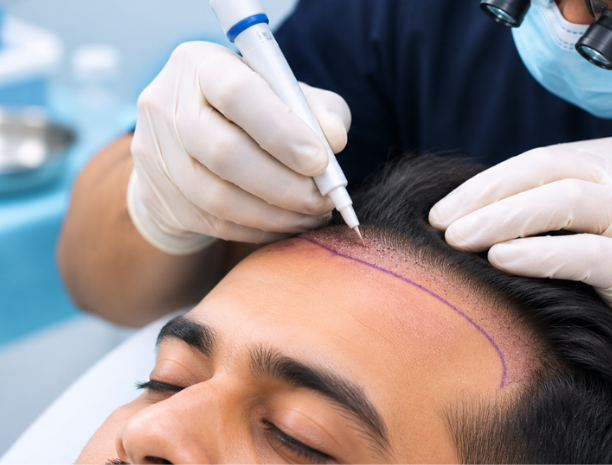
DHI stands for Direct Hair Implantation. The term is commonly used in hair restoration to describe the placement of follicular grafts using specialized implanter instruments. A hair transplant involves two main technical stages: harvesting suitable follicular units from a donor area and placing those units into the intended recipient area. DHI mainly refers to the implantation stage. In a commonly used DHI approach, follicles are harvested using Follicular Unit Excision (FUE), examined and prepared before being loaded into an implanter pen. A sharp implanter can create a small recipient-site incision and place the graft through a controlled insertion movement. The treating surgeon determines the planned graft orientation, placement depth and distribution according to the patient's existing hair and restoration goals.
What Is a DHI Implanter Pen?
A hair implanter is a specialized surgical instrument designed to assist with follicular graft placement.
It generally contains a narrow hollow needle or channel through which a prepared follicular graft can be positioned and inserted into the scalp.
Sharp and dull implanters have different functions. A sharp implanter can create a recipient site and place a graft during the same placement sequence. A dull implanter is used in an incision that has already been prepared. The term DHI is most commonly associated with the sharp implanter technique.
Is DHI a Different Type of Hair Transplant?
DHI should not be confused with a separate method of harvesting donor hair. FUE describes how individual follicular units are removed from the donor region, whereas DHI commonly describes how those grafts are implanted into the recipient area. Both stages form part of the overall hair transplantation procedure.
For a broader explanation of donor harvesting and surgical restoration, explore our Hair Transplant Treatment page.
Personalized Planning for Hair Implantation
The success of hair restoration depends on more than the type of instrument used during surgery.
At Dermatrix, consultation focuses on evaluating whether hair transplantation is appropriate and discussing the available techniques according to individual hair-loss characteristics.

4.8

1000 Verified Reviews
Detailed Scalp Assessment
The patient's scalp condition, hair-loss pattern, medical history and existing follicle distribution are assessed before developing a treatment plan.
Donor Hair Evaluation
Donor-area density, follicle characteristics and the estimated number of safely available grafts help determine whether surgical restoration is appropriate.
Hairline and Growth Direction Planning
Hairline design takes into account facial proportions, existing hair growth, intended coverage and possible future hair loss.
Recipient-Site and Implantation Planning
The selection of implantation instruments and placement methods depends on scalp characteristics, graft quality and the intended hair restoration pattern.
Aftercare and Follow-Up Guidance
Patients receive guidance regarding scalp healing, graft protection, temporary hair shedding and the expected development of transplanted hair
Who May Be a Suitable Candidate for DHI Hair Transplant?
-
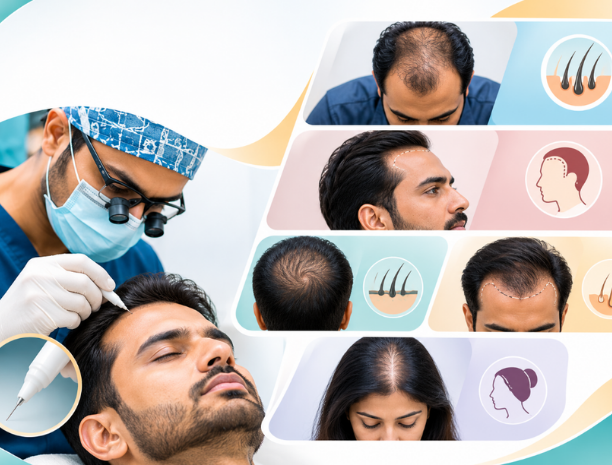
Male Pattern Hair Loss
Men with androgenetic alopecia may be evaluated for transplantation when donor hair is sufficient and the restoration plan accounts for future hair loss.
-
Receding Hairline
Patients with frontal hairline recession may be considered for implantation-based restoration after assessment of the proposed hairline, donor capacity and long-term treatment needs.
-
Frontal Scalp Thinning
Selected patients with frontal scalp thinning may be suitable for graft placement when the surrounding hair, available recipient space and donor follicles allow appropriate surgical planning.
-
Crown Hair Loss
Implanter-based techniques may be considered for selected crown restoration cases. Graft orientation and distribution require careful planning because crown hair grows in a characteristic spiral pattern.
-
Selected Female Hair Loss
Some women with suitable donor hair and localized areas of permanent hair loss may be candidates. Diffuse thinning requires careful medical evaluation before transplantation.
When May DHI Not Be Appropriate?
Hair transplantation may not be suitable for patients with insufficient donor hair, certain active scalp diseases, medically unsuitable conditions or patterns of hair loss that require nonsurgical management.
A DHI implanter does not overcome the limitations of poor donor capacity or an unsuitable medical diagnosis. The decision to proceed should follow a qualified clinical assessment.
How Does the DHI Hair Transplant Procedure Work?
The exact steps depend on the donor-harvesting method and the implantation technique selected by the treating surgeon.
Step 1: Hair Loss Assessment and Consultation
The consultation includes an examination of the patient's scalp, donor hair, existing hair density, medical history and treatment expectations. The clinician evaluates whether surgical transplantation is appropriate.
Step 2: Hairline Design and Graft Planning
The proposed treatment area is mapped according to the patient's natural hairline, facial proportions and existing hair direction. The graft requirement is estimated based on the restoration area, available donor follicles and achievable coverage.
Step 3: Donor Area Preparation and Follicle Harvesting
The scalp is prepared, and local anaesthesia is commonly administered to reduce discomfort. Individual follicular units may be harvested through the FUE technique using small circular surgical punches. The harvested grafts are then assessed and prepared for implantation.
Step 4: Graft Preparation and Implanter Loading
Suitable follicular units are carefully positioned within the implanter instrument. Graft loading requires appropriate handling to help minimize avoidable injury to the follicles. Instrument selection depends on the size and characteristics of the grafts.
Step 5: Direct Hair Implantation
Using the selected sharp implanter, the treating surgeon can create a recipient-site incision and insert the follicular graft during the placement sequence. The insertion is planned according to the desired depth, direction, angle and spacing. Different areas of the scalp may require different placement orientations.
Step 6: Final Graft Assessment and Aftercare
After implantation, the treated areas are assessed, and post-operative instructions are provided. Patients receive guidance regarding scalp washing, graft protection, activity restrictions, medication where prescribed and follow-up appointments. The transplanted follicles enter a gradual healing and hair-growth process over the following months.
How Does a DHI Implanter Pen Support Hair Graft Placement?
The implanter pen is the main feature that distinguishes commonly marketed DHI procedures from forceps-based graft placement.
Graft Loading
A harvested follicular unit is carefully loaded into the implanter instrument.
Recipient-Site Placement
With a sharp implanter, the instrument can create a small recipient-site opening during graft placement.
Angle and Direction
The operator positions the instrument according to the planned growth direction and orientation of surrounding hair.
Controlled Insertion
The graft is released through the instrument into the intended recipient position.
Does an Implanter Pen Improve Hair Transplant Results?
An implanter provides a different way to handle and place follicular grafts. It may reduce direct manipulation of certain parts of the follicle during insertion.
However, the instrument alone does not guarantee better graft survival, denser hair, faster recovery or a more natural-looking result. Proper graft preparation, surgical technique, donor selection, recipient-site planning and post-operative care remain essential.
DHI vs FUE Hair Transplant: What Is the Difference?
DHI and FUE are frequently compared, but they refer to different stages of hair transplantation. FUE describes the harvesting method, while DHI commonly refers to a graft implantation technique.
| Feature | Feature FUE | DHI |
|---|---|---|
| Primary meaning | Follicular Unit Excision | Direct Hair Implantation |
| Main focus | Individual donor follicle harvesting | Recipient graft placement |
| Typical instrument | Small circular extraction punch | Implanter pen |
| Role in transplantation | Harvests individual grafts | Places prepared grafts |
| Can be used together? | Yes | Yes |
| Surgical planning | Required | Required |
| Guaranteed higher hair density? | No | No |
| Recovery | Depends on the overall procedure | Depends on the overall procedure |
Can FUE and DHI Be Used Together?
Yes. A hair transplantation procedure may use FUE to harvest donor follicles and an implanter instrument to place those follicles into the recipient area. Therefore, DHI is not necessarily an alternative to FUE. The techniques can be complementary.
DHI vs Sapphire FUE: Which Technique Is Different?
Sapphire FUE commonly refers to the use of sapphire blades to prepare recipient-site incisions during an FUE-based transplant. DHI generally refers to an implantation method using specialized implanter instruments.
The distinction is the recipient-site preparation and graft-placement approach. Neither technique should automatically be considered superior for every patient. A treating surgeon should choose the instruments and surgical method according to the patient's clinical requirements.
What Are the Potential Advantages of DHI?
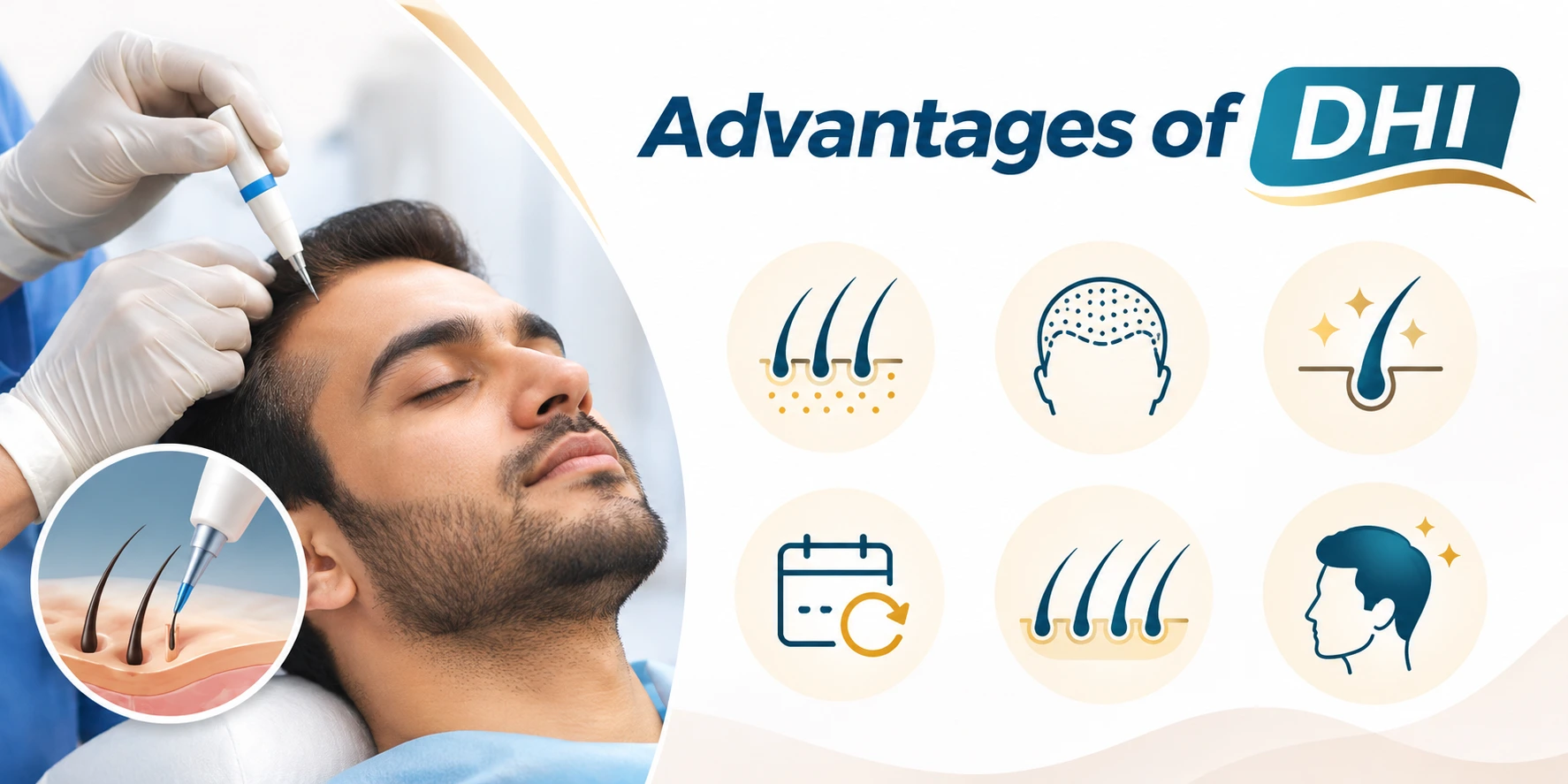
DHI offers an implantation approach that can be considered as part of a carefully planned hair transplantation procedure.
Controlled Graft Placement : - Implanter instruments allow grafts to be positioned according to a planned placement depth, direction and distribution.
Individualized Hair Direction : - The implantation process can be planned to follow the natural growth direction of nearby hair.
Alternative Graft Handling Method : - The implanter pen provides an alternative to inserting grafts directly with forceps into prepared recipient sites.
Flexibility in Recipient-Site Planning : - Implanter-based placement can be considered for selected restoration areas depending on scalp conditions, existing hair and the treating surgeon's technique.
Long-Term Hair Restoration Potential : - Transplanted follicles harvested from suitable donor regions may produce long-lasting hair growth. Individual outcomes vary, and existing hair loss can continue.
What Are the Limitations of DHI?
DHI does not create additional donor follicles or guarantee improved transplant results. The technique still involves surgical incisions, and patients may experience bleeding, swelling, scarring, temporary shedding or other complications.
Claims that DHI is completely scar-free, painless, nonsurgical or guaranteed to achieve higher density should not be considered reliable.
What Is the Recovery Timeline After DHI?
Recovery after implanter-based hair transplantation generally follows the broader healing process associated with surgical hair restoration.
Days 1–7: Initial Healing
Temporary redness, swelling, tenderness and small crusts may develop around the donor and recipient areas. Patients should follow the treating team's instructions to protect the transplanted grafts.
Weeks 2–6: Healing and Shedding
Some transplanted hair shafts may shed during the early weeks after treatment. This can be part of the normal transplantation process.
Months 3–6: Early New Hair Growth
New hair may begin appearing as transplanted follicles progress through their growth cycle. Early growth can be fine, uneven or less noticeable than the eventual result.
Months 6–9: Visible Development
Hair coverage and appearance may improve as more transplanted follicles begin producing hair.
Months 10–18: Further Maturation
Hair length, thickness and cosmetic appearance may continue developing over a longer period. The timeline varies between patients. A specific result or recovery date cannot be guaranteed.
Are There Any Risks with DHI?
Possible risks include infection or bleeding, swelling and temporary discomfort, small donor-area scars, temporary hair shedding, injury to harvested grafts, poor follicle growth, donor-area thinning, and uneven or unsatisfactory hair coverage.
A qualified treating clinician should explain the relevant risks and alternatives before transplantation.
DHI Hair Transplant Cost
What Determines the Cost of DHI Hair Transplant?
DHI Hair Transplant cost depends on the overall surgical plan, graft requirement, donor hair availability and implantation approach.
Number of Grafts
The estimated number of follicular units needed for the intended restoration area.
Extent of Hair Loss
The size and distribution of the thinning or bald areas that require treatment.
Donor Hair Characteristics
The availability and condition of follicles that may be safely harvested.
Surgical and Implantation Requirements
The selected harvesting method, implanter instruments, surgical complexity and treatment duration.
Treatment and Aftercare Services
The medical services, follow-up consultations and post-operative care included in the proposed plan.
Is DHI More Expensive Than FUE?
DHI-based treatment may be priced differently because of instrument requirements, graft loading, surgical workflow and clinic-specific practices.
However, DHI should not automatically be described as more expensive or more effective than conventional implantation methods.
For guidance on local hair transplantation pricing, read our Hair Transplant Cost in Thane page.
DHI Hair Transplant FAQs – Your Questions Answered
-
What is DHI Hair Transplant?
DHI stands for Direct Hair Implantation. It commonly describes a technique in which harvested follicular grafts are placed into the scalp using specialized implanter instruments. It is an implantation approach rather than a separate donor-harvesting method.
-
How does Direct Hair Implantation work?
Suitable follicles are harvested from a donor area and prepared for transplantation. The grafts are loaded into an implanter, which is used to position them in the planned recipient area.
-
What is the difference between DHI and FUE?
FUE describes the method used to harvest individual follicular units. DHI commonly describes how prepared grafts are placed into the recipient area. Both can be used during the same hair transplant.
-
Is DHI better than traditional FUE?
Not necessarily. The two terms describe different technical stages of transplantation. There is insufficient evidence to claim that DHI always produces superior results. Patient selection, donor quality and surgical technique remain important.
-
What is a DHI implanter pen?
An implanter pen is a surgical tool used to place harvested follicular grafts. A sharp implanter can make a recipient-site incision and insert the graft during a controlled placement sequence.
-
Does DHI Hair Transplant require incisions?
Yes. Hair transplantation requires donor harvesting and recipient-site placement. Sharp implanters create small skin incisions while placing grafts, so DHI is not an incision-free procedure.
-
Does DHI Hair Transplant leave scars?
Small scars may occur in the donor area, particularly when follicles are harvested using FUE. DHI does not eliminate the possibility of scarring.
-
Is DHI Hair Transplant painful?
Local anaesthesia is commonly used to reduce discomfort during transplantation. Some patients may experience temporary pain, sensitivity or swelling afterward.
-
Is DHI suitable for hairline restoration?
Implanter-based placement may be considered for suitable hairline restoration cases. The surgical plan should consider hairline shape, natural direction, donor availability and future hair loss.
-
Can DHI be used for crown hair transplantation?
DHI may be considered in selected crown restoration cases. Graft placement must account for the crown's natural spiral growth pattern and available donor follicles.
-
Can women undergo DHI Hair Transplant?
Selected women may be candidates for hair transplantation. Suitability depends on the cause of hair loss, donor hair condition and treatment goals. Diffuse thinning requires careful evaluation.
-
Does DHI guarantee higher hair density?
No. Hair density depends on donor hair availability, graft selection, recipient-site planning, existing hair and individual healing. The use of an implanter pen alone does not guarantee higher density.
-
How long does DHI Hair Transplant take?
The duration depends on the graft requirement, donor harvesting, graft preparation and implantation workflow. An estimate can be provided after clinical assessment.
-
When will new hair grow after DHI?
New growth commonly starts becoming noticeable after several months. Many patients see improvement between 6 and 12 months, with some results continuing to mature for up to 18 months.
-
Is DHI Hair Transplant permanent?
Follicles transplanted from suitable donor regions may provide long-lasting growth. Existing non-transplanted hair may continue thinning, and long-term results vary.
-
Is shaving compulsory for DHI Hair Transplant?
Shaving requirements depend on the harvesting technique, treatment area, graft requirement and surgical plan. DHI does not automatically mean the transplant can be performed without shaving.
-
Is DHI Hair Transplant suitable for everyone?
No. Suitability depends on donor capacity, the cause and progression of hair loss, scalp health, medical history and realistic restoration goals.
-
How much does DHI Hair Transplant cost?
The cost depends on graft requirements, treatment complexity, surgical technique and included medical services. A personalized estimate requires clinical evaluation.
-
How is Sapphire FUE different from DHI?
Sapphire FUE refers to using sapphire blades during recipient-site preparation. DHI commonly refers to graft placement using an implanter instrument. Both are related to the implantation stage and may use FUE donor harvesting.
-
How can I enquire about DHI at Dermatrix?
You can contact Dermatrix for a hair restoration consultation. The team can assess your hair-loss concerns, discuss suitable transplantation approaches and confirm the availability of DHI implantation at the relevant clinic.
Related Hair Restoration Services
Explore More Hair Transplant Options at Dermatrix
Hair Transplant Treatment
Understand the overall hair transplantation process, including donor assessment, graft harvesting, recipient-site planning and recovery.
Explore Hair Transplant Treatment
Hair Loss Treatment
Hair thinning does not always require surgery. Learn about diagnosis-led hair-loss management and available treatment options.
Hair Transplant in Thane
Explore location-specific information about hair restoration consultations and surgical treatment planning.
Explore Hair Transplant in Thane
Book Your Hair Restoration Consultation
Is DHI Hair Implantation Right for You?
Selecting a hair transplantation approach requires a clear understanding of your hair-loss condition, available donor follicles and realistic treatment expectations.
A Dermatrix hair restoration consultation can help you understand your options, discuss implantation techniques and evaluate whether surgical restoration may be appropriate.
 Contact us
 Book Appointment
