

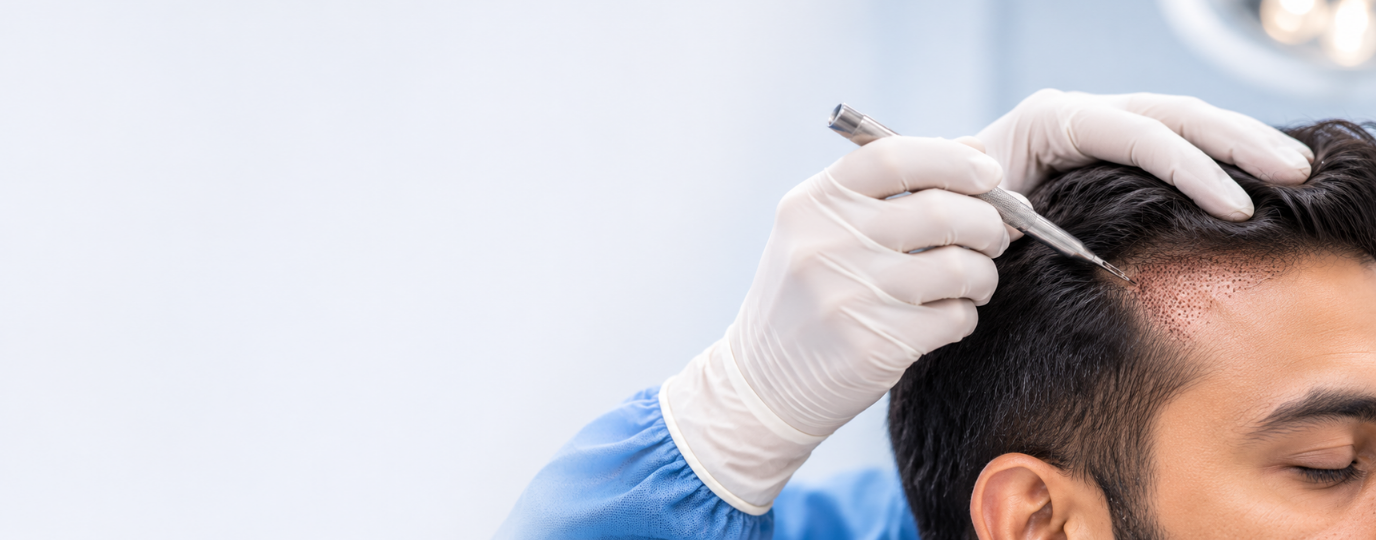
FUE Hair Transplant At Dermatrix
Discover FUE hair transplant at Dermatrix. Understand follicle extraction, suitability, procedure steps, recovery, risks and cost factors before consultation.
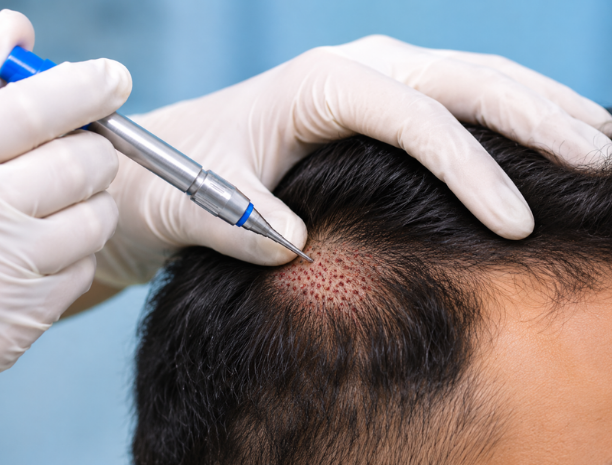
What Is FUE Hair Transplant?
FUE stands for Follicular Unit Excision, also commonly known as Follicular Unit Extraction. It is a hair transplantation technique in which individual follicular units are removed from a suitable donor area using small circular surgical punches. The harvested grafts are then placed into selected areas of the scalp where additional hair coverage is required. A follicular unit is a naturally occurring grouping of hair follicles, often containing one to four hairs. In FUE transplantation, the donor area is usually located at the back or sides of the scalp, where suitable follicles may be more resistant to the effects of androgenetic hair loss. Unlike the traditional strip-harvesting method, FUE does not require removing a long strip of scalp tissue. Instead, individual follicular units are harvested through small circular incisions.
How Does FUE Restore Hair?
FUE transplantation relocates existing hair follicles rather than creating new follicles.
The transplanted follicles are placed into areas affected by permanent thinning or baldness, where they may continue producing hair after healing.
Successful treatment requires careful consideration of donor follicle quality, graft handling, recipient-site preparation, hair direction and future hair-loss progression.
To understand the broader surgical restoration process, explore our Hair Transplant Treatment page.
Personalized FUE Hair Restoration Planning
Every patient's donor hair availability, pattern of hair loss and desired coverage are different. FUE treatment should therefore be planned according to individual clinical findings rather than a fixed graft count or standard surgical package.
Dermatrix emphasizes assessment-led hair restoration consultations that help patients understand their treatment options and expected outcomes.

4.8

1000 Verified Reviews
Detailed Donor Area Assessment
The donor area is examined for follicle distribution, hair density, scalp condition and the number of grafts that may be safely available.
Individualized Graft Planning
The proposed number of grafts is considered alongside the treatment area, existing hair, coverage goals and long-term donor preservation.
Natural Hairline Design
Hairline planning considers facial proportions, age, existing hair direction and the possibility of continued hair loss.
Surgical Technique Selection
FUE instruments and recipient-site preparation methods are selected according to the patient's clinical requirements and treatment plan.
Aftercare and Follow-Up Guidance
Patients receive information about donor-area healing, recipient-site recovery, temporary shedding and the gradual development of transplanted hair.
Who May Be a Suitable Candidate for FUE Hair Transplant?
-
Male Pattern Hair Loss
Men with androgenetic alopecia may be suitable candidates when the donor area contains sufficient healthy follicles and the proposed restoration plan considers future hair-loss progression.
-
Receding Hairline
Patients experiencing frontal hairline recession may be evaluated for FUE hairline restoration. The proposed hairline should consider facial proportions, existing hair and long-term donor availability.
-
Crown Hair Loss
FUE transplantation may be considered for crown thinning or baldness. The required graft distribution depends on the crown's size, existing hair and natural spiral growth pattern.
-
Localized Permanent Hair Loss
Some patients with stable areas of permanent hair loss may be suitable for transplantation, depending on the scalp condition and underlying cause.
-
Selected Female Hair Loss Cases
Women with suitable donor follicles and certain localized patterns of permanent hair loss may be considered. Diffuse thinning requires careful diagnosis before surgery is recommended.

When Might FUE Not Be Suitable?
FUE may not be recommended when a patient has insufficient donor follicles, active scalp disease, certain untreated medical conditions or a pattern of hair loss that is unsuitable for transplantation.
Patients with rapidly progressing hair loss may also need further evaluation and long-term planning before surgery. A medical consultation is essential to determine whether FUE is appropriate.
How Does the FUE Hair Transplant Procedure Work?
FUE hair transplantation involves individually harvesting follicular units, preparing the recipient area and placing the selected grafts according to a personalized surgical plan.
Step 1: Scalp and Donor Hair Evaluation
The consultation includes examination of the scalp, donor follicle density, hair thickness, existing hair and the areas requiring restoration. Medical history, previous hair-loss treatments and future hair-loss expectations are also considered.
Step 2: Hairline Design and Graft Estimation
The treating team plans the intended hairline or restoration area based on the patient's facial features, natural hair direction, donor capacity and expected coverage. The estimated graft requirement is determined after examining the donor and recipient regions.
Step 3: Donor Area Preparation and Local Anaesthesia
The donor area is prepared according to the selected FUE approach. Hair trimming or shaving may be required depending on the treatment plan. Local anaesthesia is commonly used to reduce discomfort during harvesting and transplantation.
Step 4: Individual Follicular Unit Excision
Using a small circular punch, the treating surgeon makes incisions around selected follicular units. These units are carefully removed from the donor region while aiming to minimize damage to the follicles and preserve the surrounding donor hair. Punch selection, extraction angle and graft handling are important technical factors during this stage
Step 5: Recipient-Site Preparation and Graft Placement
The recipient area is prepared according to the intended direction, angle, spacing and distribution of the transplanted hair. The harvested follicular units are then placed into the planned locations using an appropriate implantation method.
Step 6: Post-Procedure Care and Follow-Up
After treatment, patients receive instructions for scalp washing, protection of the transplanted grafts, activity restrictions and follow-up appointments. Temporary redness, swelling, crusting or sensitivity may occur during early recovery. Hair growth develops gradually over the following months.
Why Is Donor Hair Preservation Important in FUE?
One of the most important parts of FUE hair transplantation is protecting the donor area.
The number of available donor follicles is limited. Excessive removal can create visible thinning, uneven density or unwanted scarring.
Before planning FUE, the medical team should consider:
- Donor hair density and distribution.
- Follicle characteristics and hair thickness.
- Existing donor-area thinning or scarring.
- The number of grafts required for the planned coverage.
- The possibility of future hair loss.
Whether donor follicles may be needed for a later procedure.
Can FUE Cause Donor Area Thinning?
Yes. Excessive follicle harvesting or poor donor-area planning can reduce visible hair density and affect the appearance of the donor region. Careful extraction planning is important for maintaining a balanced donor appearance.
Does FUE Leave Scars?
FUE avoids the long linear scar associated with strip harvesting, but the individual extraction points can leave small circular scars. Their visibility depends on factors such as punch size, extraction density, skin characteristics, healing and hairstyle. FUE should not be described as a completely scar-free procedure.
What Are the Potential Advantages of FUE Hair Transplant?
Individual Follicle Harvesting
FUE allows individual follicular units to be selected and harvested rather than removing an entire strip of scalp.
No Long Linear Donor Incision
Because FUE does not require strip harvesting, it avoids the continuous linear donor scar associated with FUT.
Flexible Graft Selection
Follicular units can be selected from suitable areas of the donor region based on the surgical plan and follicle characteristics.
Personalized Hairline Restoration
Careful graft distribution and implantation can support restoration designed around the patient's natural hair direction and facial proportions.
Long-Term Hair Growth Potential
Follicles harvested from appropriate donor regions may continue producing hair over the long term, although outcomes vary.
Suitable for Different Restoration Areas
FUE may be considered for selected hairline, frontal scalp and crown restoration cases, depending on donor availability and clinical suitability.
Important Limitations FUE Hair Transplant
FUE does not stop future hair loss in existing, non-transplanted follicles. It also cannot guarantee a particular density, growth rate or cosmetic result. The procedure requires suitable donor follicles, careful surgical planning and realistic expectations.
FUE vs FUT Hair Transplant
What Is the Difference Between FUE and FUT?
FUE and FUT are two established methods of harvesting donor hair for transplantation.
| Feature | FUE Hair Transplant | FUT Hair Transplant |
|---|---|---|
| Donor harvesting | Individual follicular units | Strip of donor scalp tissue |
| Main harvesting instrument | Small circular punch | Surgical strip excision |
| Donor closure | No long strip wound to close | Strip incision generally closed with sutures or staples |
| Typical donor scarring | Multiple small circular scars | Linear scar |
| Graft preparation | Individually harvested units | Units separated from the harvested strip |
| Recovery | Varies by surgical extent and patient | Varies by surgical extent and patient |
| Suitability | Depends on donor and treatment plan | Depends on donor and treatment plan |
Is FUE Better Than FUT?
Neither technique is automatically suitable for every patient. FUE may be preferable for patients who wish to avoid a linear donor scar, while FUT may be appropriate in selected cases based on donor characteristics, graft needs and surgical planning. A qualified hair restoration surgeon should explain the advantages, limitations and risks of each method before treatment.
FUE, Sapphire FUE and DHI
Understanding Different Hair Transplant Techniques
Patients frequently compare FUE, Sapphire FUE and DHI when researching hair transplantation. Although these terms are often marketed as separate procedures, they describe different aspects of surgical hair restoration.
FUE – Follicular Unit Excision
FUE primarily describes how individual follicular units are harvested from the donor area.
Sapphire FUE
Sapphire FUE generally uses FUE harvesting combined with sapphire blades for recipient-site incision creation.
DHI – Direct Hair Implantation
DHI is a term commonly used for certain implantation approaches, including the use of implanter instruments to place follicular units.
Which Technique Should You Choose?
The appropriate technique depends on the donor area, scalp condition, recipient-site requirements, expected graft count and the treating surgeon's assessment. Rather than selecting treatment based on a technique name alone, patients should understand the harvesting method, implantation process and qualifications of the medical professional performing the surgery.
FUE Hair Transplant Recovery Timeline
Days 1–7: Initial Scalp Healing
Temporary redness, swelling, tenderness and small crusts may appear in the donor and recipient areas. Patients should follow the treating team's specific instructions.
Weeks 2–6: Healing and Shedding
The scalp continues healing, and some transplanted hair shafts may shed. This temporary shedding can occur before new hair begins growing.
Months 3–6: Early Hair Growth
New hair may begin appearing from transplanted follicles. The initial growth may be fine or uneven.
Months 6–9: Visible Development
Hair coverage and appearance may improve as transplanted follicles continue producing hair.
Months 10–18: Continued Maturation
Hair thickness, length and cosmetic appearance may continue developing. Some areas, particularly the crown, can take longer to mature.
These timelines are approximate. Individual results vary, and follow-up appointments are important for assessing recovery and growth.
Possible FUE Hair Transplant Risks
Like other surgical procedures, FUE can involve complications. These may include bleeding, infection, swelling, scarring, temporary hair shedding, graft injury, poor graft growth, donor-area thinning or an unsatisfactory cosmetic result. Patients should discuss the risks, benefits and alternatives with their treating surgeon before making a decision.
FUE Hair Transplant Cost
What Determines FUE Hair Transplant Cost?
FUE hair transplant cost depends on the patient's individual treatment requirements.
The total estimate may be influenced by:
- The number of follicular units required.
- Donor hair density and availability.
- The size and location of the restoration area.
- Hairline and crown coverage requirements.
- Surgical complexity and the selected treatment approach.
- The services included in the treatment and aftercare plan.
Because donor availability and graft requirements differ between patients, a personalized scalp evaluation is recommended before estimating cost.
For detailed local pricing guidance, visit our Hair Transplant Cost in Thane page.
Have questions or ready to book your consultation?
Fill in your details and our team will reach out to you shortly.
FUE Hair Transplant FAQs
-
What does FUE stand for in hair transplantation?
FUE stands for Follicular Unit Excision. It is also widely known as Follicular Unit Extraction. The technique involves individually harvesting follicular units using small surgical punches.
-
How is FUE Hair Transplant performed?
Suitable donor follicles are individually harvested using FUE instruments. The extracted grafts are then placed into prepared recipient sites according to the surgical restoration plan.
-
Is FUE Hair Transplant permanent?
Transplanted follicles from suitable donor regions may produce long-lasting hair growth. However, existing non-transplanted hair can continue thinning, and individual results vary.
-
Does FUE Hair Transplant leave scars?
FUE can leave small circular donor-area scars. It avoids the long linear donor scar associated with FUT but should not be considered completely scar-free.
-
Is FUE Hair Transplant painful?
FUE is usually performed under local anaesthesia to reduce discomfort during the procedure. Temporary soreness, tenderness or sensitivity may occur afterward.
-
How many grafts are required for FUE?
The number depends on the size of the restoration area, donor density, hair characteristics and treatment goals. An accurate estimate requires scalp and donor evaluation.
-
How long does an FUE Hair Transplant take?
The duration depends on graft count, the harvesting and implantation process, and whether treatment is planned over one or more sessions.
-
How long does FUE Hair Transplant take to heal?
Early scalp healing occurs over the first days and weeks. The time required to return to normal activities varies by procedure and individual recovery.
-
When will new hair grow after FUE?
New growth often begins becoming noticeable several months after surgery. Visible improvement can develop over 6–12 months, while some results continue maturing for up to 18 months.
-
Can FUE treat crown baldness?
FUE may be suitable for selected crown restoration cases. The decision depends on crown size, donor capacity and the overall hair restoration plan.
-
What is the difference between FUE and Sapphire FUE?
FUE refers to individual follicular unit harvesting. Sapphire FUE generally uses the same harvesting approach but involves sapphire blades during recipient-site preparation.
-
What is the difference between FUE and DHI?
FUE describes a follicular unit harvesting method, while DHI commonly refers to a graft implantation approach. These terms are not always mutually exclusive.
-
Can women undergo FUE Hair Transplant?
Some women with selected patterns of permanent hair loss may be suitable candidates. A diagnosis and donor assessment are essential, particularly when thinning is diffuse.
-
Can FUE damage donor hair?
Graft injury, overharvesting or inadequate donor-area planning can affect donor hair appearance and transplant outcomes. Careful technique and responsible donor management are important.
-
How much does FUE Hair Transplant cost?
The cost depends on the estimated graft requirement, donor availability, restoration area, surgical complexity and included services. A personalized estimate requires consultation.
-
Can I view FUE Hair Transplant results at Dermatrix?
Dermatrix publishes hair transplant patient case studies and treatment information. These can help patients understand different treatment journeys, but individual results may vary.
-
How do I book an FUE Hair Transplant consultation at Dermatrix?
You can contact Dermatrix through the website to arrange a hair restoration consultation. The team can provide information about treatment suitability, available locations and appointment options.
Related Hair Restoration Services
Hair Transplant Treatment
Learn about the complete hair transplantation process, donor assessment, graft planning and available surgical restoration options.
Explore Hair Transplant Treatment
Hair Loss Treatment
Not every case of hair thinning requires transplantation. Explore diagnosis-led treatment options for different patterns of hair loss.
Hair Transplant Consultation in Thane
Find location-specific information about scalp assessment, donor evaluation and hair restoration consultation in Thane.
 Contact us
 Book Appointment
